The stars and sliver of moon drew my eyes skyward during my early morning dog walk.
How can just a slice of moon throw out that much light? Would a star fall from the sky?
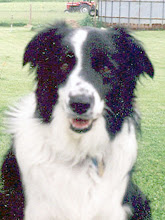
The Border collie standing in the middle of the driveway interrupted my thoughts. Hackles up, Caeli was staring at the waterway that stretches across the fields in front of our house.
My eyes followed her stare.
The moon illuminated black shapes.
Calling the dogs, I hustled them back to the house and retrieved the spotlight. From the safety behind the fence in the yard, I shone the light across the waterway.
Cows.
In the fall, the neighbor lets his cows graze the harvested fields. The cows found our alfalfa field more tempting and escaped in the night.
Returning to the house, I looked at the oven clock glowing in the darkness.
4:53.
No one wants to call their neighbors at 5 in the morning.
I took the spotlight back outside and illuminated the waterway.
Yep, they were definitely cows and they were definitely on the amble away from their farm.
And so I made the call--revealing to the neighbor that his cows were on the loose and letting him assume that it was a barking dog that awoke me from my sleep.
Showing posts with label Livestock. Show all posts
Showing posts with label Livestock. Show all posts
Friday, November 20, 2015

Friday, February 20, 2015
The Critter Thermometer
I expect cold snaps in winter, but when they come early and late in the season, they seem especially cruel.
When cold hit in November, it seemed to catch us by surprise. We didn't have the water heaters in place, the gloves dug out from storage, the body used to the cold. And when it hit this past week, I was already photographing dandelions and looking for shades of green in the grass.
I don't keep an outdoor thermometer. The critters tell me when temperatures have dropped below zero.
That happened yesterday when:
Dewey Kitty went outside and was crying to come back in after four minutes.
The horses, usually hanging out in the pastures at night, were standing in their stalls in the morning.
Llambert the Llama had icicles hanging from his eyelashes.
The Border collies dashed outside for their morning walk, but 300 yards into it, three of the four were lifting their paws in that ouchy way.
The sheep ate their first-cutting hay without complaint. (The girls get first cutting to nibble on throughout the day and get the third-cutting alfalfa in the evenings).
And, it's even colder this morning. How do I know?
Dewey Kitty didn't even ask to go outside. He's lounging on his polar fleece blanket, content in watching me.
When cold hit in November, it seemed to catch us by surprise. We didn't have the water heaters in place, the gloves dug out from storage, the body used to the cold. And when it hit this past week, I was already photographing dandelions and looking for shades of green in the grass.
I don't keep an outdoor thermometer. The critters tell me when temperatures have dropped below zero.
That happened yesterday when:
Dewey Kitty went outside and was crying to come back in after four minutes.
The horses, usually hanging out in the pastures at night, were standing in their stalls in the morning.
Llambert the Llama had icicles hanging from his eyelashes.
The Border collies dashed outside for their morning walk, but 300 yards into it, three of the four were lifting their paws in that ouchy way.
The sheep ate their first-cutting hay without complaint. (The girls get first cutting to nibble on throughout the day and get the third-cutting alfalfa in the evenings).
And, it's even colder this morning. How do I know?
Dewey Kitty didn't even ask to go outside. He's lounging on his polar fleece blanket, content in watching me.
Sunday, November 17, 2013
You Don't Know...
Ian, the shepherd's son, was sitting in class when the teacher gave him a math story problem.
"If you have 20 sheep in the pasture and five find a hole in the fence and go through it, how many sheep are left in the pasture?"
"None," he answered.
"Fifteen," the teacher said, adding, "You don't understand math."
"You don't understand sheep," he said.
I thought of this story this week when a herd of horses got out of their pasture, resulting in numerous traffic accidents and several horses being killed on the road.
As an animal owner, this is one of my biggest fears. While I take steps to have secure fencing, it's never a guarantee. A gate could be left open, a fence could be cut, a spooked animal could go through or over it.
The comments that I heard about the loose horses story this week were almost as distressing.
The news reporter called them "these things" (they are animals) and commented that these "are full-grown horses, not ponies. They could do some damage." Ponies which can weigh 600-1,000 pounds -- considerably more than deer -- could also do some damage.
Then I heard comments like:
Why would all 39 horses leave the pasture?
They must have been abused.
They must have been starving.
Why did they run so many miles from home?
I felt like Ian, the boy in the story, trying to explain herd dynamics and flight response. And I was again reminded how far most of the population is from agriculture and understanding livestock.
"If you have 20 sheep in the pasture and five find a hole in the fence and go through it, how many sheep are left in the pasture?"
"None," he answered.
"Fifteen," the teacher said, adding, "You don't understand math."
"You don't understand sheep," he said.
I thought of this story this week when a herd of horses got out of their pasture, resulting in numerous traffic accidents and several horses being killed on the road.
As an animal owner, this is one of my biggest fears. While I take steps to have secure fencing, it's never a guarantee. A gate could be left open, a fence could be cut, a spooked animal could go through or over it.
The comments that I heard about the loose horses story this week were almost as distressing.
The news reporter called them "these things" (they are animals) and commented that these "are full-grown horses, not ponies. They could do some damage." Ponies which can weigh 600-1,000 pounds -- considerably more than deer -- could also do some damage.
Then I heard comments like:
Why would all 39 horses leave the pasture?
They must have been abused.
They must have been starving.
Why did they run so many miles from home?
I felt like Ian, the boy in the story, trying to explain herd dynamics and flight response. And I was again reminded how far most of the population is from agriculture and understanding livestock.
Saturday, February 16, 2013
Quality of Life: The Dark Side
If I wanted to keep my hens safe from sheep hooves, hawks and dogs, I'd lock them inside the chicken house.
They'd protest.
The desire to stretch their wings, fly, scratch and peck, roam, is embedded in their DNA.
Each morning, I let them out of the hen house to go about their daily business of being chickens.
Each evening, after they return to roost, I lock them in.
But every once in a while -- about once or twice a year -- the number returning is one less.
That happened yesterday when I went outside to do the evening chores.
I spotted the hen immediately. Her lifeless body lay next to the fence that separated the ram and sheep pens. Apparently she'd flown into the ram pen and was unable to escape the territorial ram.
Picking her up, I took her in the barn where I removed the yellow leg band that signified a 2011 model.
Then, I scooped up some scratch grain and offered it to the remaining hens and roosters who cooed and scratched and strutted and delighted in the late afternoon snow.
They'd protest.
The desire to stretch their wings, fly, scratch and peck, roam, is embedded in their DNA.
Each morning, I let them out of the hen house to go about their daily business of being chickens.
Each evening, after they return to roost, I lock them in.
But every once in a while -- about once or twice a year -- the number returning is one less.
That happened yesterday when I went outside to do the evening chores.
I spotted the hen immediately. Her lifeless body lay next to the fence that separated the ram and sheep pens. Apparently she'd flown into the ram pen and was unable to escape the territorial ram.
Picking her up, I took her in the barn where I removed the yellow leg band that signified a 2011 model.
Then, I scooped up some scratch grain and offered it to the remaining hens and roosters who cooed and scratched and strutted and delighted in the late afternoon snow.
Tuesday, March 23, 2010
What birth date would you choose?
Would you want to be born in early spring? To feel the first rays of spring sun? To taste the first sprouts of green grass? To romp in the last wet snowfall of the season?
Or would you choose late spring, when the pastures provide a soft warm blanket of green, when the ground is firm, and much of the mud gone?
Last year, we chose early spring -- March 25 -- as the beginning of lambing season. Esther, the ewe, either ignored the calendar or became impatient or, like her mother, was contrary, and delivered a few days earlier.
This year, hoping for a little less mud and a little more pasture, we selected April 16. We know there's no guarantee that nature will give those lambs a sunny, warm welcome.
After years of planning birth dates, we know that nature, as always, has the final say.
Sunday, January 17, 2010
Mid-Winter Mud
The sheep and llama are upset with me. The horse is ticked.
I am no Merry Sunshine.
We've had above freezing temperatures for several days now. The snow is almost melted, and rains are expected today. It's the perfect recipe for mud.
Hooves on saturated ground churn the ground, kill the grass, create a muddy mess. So, to preserve pastures, the horse and sheep are moved to the barn and paddocks.
For them, it means less exercise, less room to roam, more boredom. For me, it means more manure, more maintenance.
I watch the weather forecast for freezing temperatures. They watch me for a cue that they can return to their pastures.
Friday, January 8, 2010
Bred for Snow


 Lily's ancestors came from the mountains of Austria and northern Italy.
Our Katahdin sheep were developed in Maine.
As for the llama, his kin came from the Andes mountains.
This handsome Buckeye rooster comes from a line developed to withstand Ohio winters. This guy, with his pea comb, doesn't have to worry too much about frostbite.
And so today, all of the critters said, "Cool, snow," and went about their daily living.
Tuesday, January 5, 2010
Musical Buckets
Three times a day, I set out water for the outdoor cats, who follow me to the barn where they drink water from the heated sheep bucket.
The chickens, too, drink from the heated sheep bucket and ignore the water I set out for them.
The sheep drink from the chicken water bucket, which I take inside when it freezes.
Both the indoor cats and the dogs drink from the livestock water buckets thawing inside.
But the dogs won't drink from the bucket of water that I offer them.
Instead, they go upstairs to the indoor cats' water bowl and drink it dry several times a day.
Monday, January 4, 2010
Easy Living
The sheep and pony are better built for this weather than me.
Temperatures haven’t reached 20 degrees for days. Winds are constant. My time outside is limited to morning and afternoon chores, trips to the woodshed, and quick potty walks for the dogs.
The livestock go about their daily routine, munching hay and grazing. Give them a windbreak, plenty of hay and water, and it’s easy living for them. There are no pesky flies nor mud to bother them.
Thursday, December 31, 2009
Winter Ground
In late December, my garden sits dotted in snow. The only green comes from the few spinach plants I neglected to pluck.
While I turn to the pantry and supermarket for my produce, the animals still eat from the land.
I turned the sheep and pony onto their winter pastures this week. These are the places the animals may only tread when the ground is summer hard or winter frozen. I don’t want hooves ripping the sod.
The animals leave the pile of hay behind, and instead choose to paw away the snow and eat the greens hiding under winter’s blanket.
Subscribe to:
Comments (Atom)

 Posts
Posts