Showing posts with label dog training. Show all posts

Wednesday, September 30, 2020

Sisters: Not Synonymous with Same


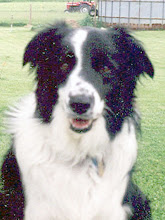
Frost and Gael wait their turn.

When I walk out into the pasture to train my Border collies, I bring a training plan, my hat, a whistle and lead line. I also bring a constant reminder: Gael and Frost may be littermates, but they are not the same.

I raised Gael from a puppy and bought Frost as a 2-year-old. They share the same parents, are both sensitive and both black and white. That's where the similarities seem to end.

Frost naturally has square flanks and a tendency to run wide; Gael naturally runs tight and has a tendency to slice her flanks.

Gael is very keen and focused on the sheep. Frost, too, wants to work the sheep, but is not as keen and more worried about listening to me.

Frost is a bossy, alpha female. Gael is submissive to other dogs.

Because of a broken femur and torn ACL, Gael is about a year behind in her training than Frost, and that difference is the hardest for me to remember. While I work with Frost to drive the length of the field and respond to whistle commands, I have to remind myself that Gael isn't solid on whistles, and that we're working on doing short drives correctly.

To avoid those sibling comparisons, I've started working on different elements. This morning, I worked on shedding, or splitting off a group of sheep, with Frost, while I did outruns and small drives with Gael. At the end of each session, I found myself telling each one that they did a good job.

This training strategy may also have another benefit: keeping sibling rivalry at bay.


Monday, May 11, 2020

Dog Training during a Pandemic

Frost practices penning over the weekend.

When I receive the Outlook calendar notifications, I'm reminded of where I planned to be this spring: at dog trials in Virginia, Tennessee, Wisconsin, Kentucky and Colorado.

Instead, I'm at home, training dogs and discovering some truths about myself, my dogs and training.

1. I like training and working dogs. Some love competition above all else. Others prefer to train. Others just love the farm work. The absence of competition made me realize that while I like the competitions, I also like working my dogs. With no competitions in the near future, I could stay inside when the cold wind blows (which it's been doing a lot this spring), but nearly every day I'm working the dogs. Even when moving the sheep to pastures, I find myself throwing in a little drive or flank work with the dogs.

2. Dog training has become more thoughtful and less stressful. Instead of reacting to a recent trial or preparing for the next one, I focus on what I, or the dog, need to work on. With my older dog Bubba, I've been playing around with shedding and penning, paying attention to where he is and where I am, and how we can impact the sheep. With my young dog Frost, we continue to work on driving, but throw in other exercises. This past weekend, we worked on penning and started some shedding training. If something's not working, I stop, think about what I can change and try again the next day. She's relaxed and eager to work every day.

3. More time means the young dog gets more practical farm work. If I have to move or sort sheep, and I'm in a hurry, I use an experienced dog. With more time, I can set up the situation where the young dog is likely to be successful. So Frost has helped move ewes and lambs, drive groups into the barn and other tasks.

But training in pandemic time has its downsides, too.

1. Staying at home doesn't put the needed miles on the dog. I still need to get Frosty out to new places where the terrain and the sheep are different.

2. Clinics or observations from experienced handlers are lacking. I tend to a wishful observer and benefit from professional input. While videoing a session helps, it's not the same as in-person observations.

3. It can be lonely. Sheepdog training has its highs and lows, and it's always more fun to have people to commiserate with and laugh about it.

Eventually my Outlook calendar will stop reminding me about canceled events, and eventually the dogs and I will get out and about again. I'm hopeful that we have benefited from pandemic time training.


Monday, January 6, 2020

What They Remember (Gael Returns to Herding Sheep)

I was more anxious than the dog.

Last week, Gael, my 2-year-old Border collie, returned to working sheep after a 13-month layoff.

A freak accident (hitting a board fence while playing with other dogs) caused a broken femur and torn ACL late in 2018. After two surgeries and months of rehabilitation she was deemed ready to go back to herding.

Before her accident, Gael had about 6 weeks of herding training. She'd been introduced to sheep in a calm and quiet manner and learned how to do balance work and some small outruns.

Would she remember that training? Or, would she be wild and crazed about working sheep?

My friend, Kay, who had started Gael on sheep, put Gael on a long line, walked her toward the sheep and asked for a lie down. Gael faced the sheep and dropped.

I held my breath, and then relaxed as Gael thoughtfully circled the sheep and did some balance work. Later, in the big field, when the sheep escaped to the barn, she quietly gathered them and brought them back. She hadn't forgotten her training.

During my time working dogs in Texas and the long drive home, I thought a lot about what dogs remember.

Bubba, my open dog, was raised, trained and trialed by Kay. I've been working him since May--and he's working well for me. However, when I sent him on a long outrun to gather a group of sheep near Kay, his muscle memory said, "bring the sheep to Kay." When a friend visits, Bubba remembers all the treats that friend fed him as a puppy. He sits in front of her and awaits a treat. When it's dinner time, he runs to his old crate in Kay's kennel and awaits his meal.

When I train dogs later today and in the coming days, I will be more conscious of what I'm teaching the dogs and making sure those are memories I want them to keep for weeks and years to come.

Meanwhile on the farm:
While I was away in Texas, it rained and rained. The cracks in the pasture from this summer's drought are almost gone and we have the dreaded winter mud. If given the choice between 30 or 40-degree days, I'll choose the 30-degree days, frozen ground and no mud. However, since there is no snow covering the ground, the sheep are happily grazing the pastures. So, for now, I'm keeping the slogging through the mud to a minimum.

.


Wednesday, October 23, 2019

Little Victories on the Sheepdog Trial Field

The trial field at Edgeworth.

I can fill pages with everything I learned at the Virginia Triple Crown Sheepdog Trials. (But, because this is a blog--I'll refrain, sort of, I promise).

Over the course of nine days, Bubba ran six times on three different fields with three different types of sheep. Emma ran five times.

My main goal was to continue forming a partnership with Bubba. He arrived at the farm in late May, fully trained. But he has a different style than my previous dogs--and I have a different style than his previous handler. We aren't yet a solid team (though we made big leaps over the past few weeks).

I also wanted to get more experience on working on big fields with different types of sheep.

So here's a little about what we learned:
1. A dog that finds sheep at 600 yards away is an amazing thing.
I have never sent a dog 600 yards to find sheep, and I stood at the post, whistle at the ready, watching and hoping. The dogs took off, looking and casting out, running over hills and out of sight a few times, and I had to trust they were on the right path. They were.

2. Both of my dogs did poorly at flanking on the fetch (until they got closer to me).
That means I'm going to have to practice flanking on the fetch, walking out to correct them, and to keep increasing my distance. It'll be a good winter project.

3. Eleven minutes is a really long time.
Over the past few years, I've really worked on focusing and observing what my dog and the sheep are doing on the field (instead of what I hope they are doing). As the dog is working, I'm watching and asking: When I give a flank whistle, does my dog take it? Does he slice his flank? How are the sheep responding? Where is the line? This still doesn't come  naturally to me. Thus, 11 minutes is a really long time. (Most courses I run are in the 8-minute range).

4. Even at a sheepdog trial, you can phone a friend.
With Bubba, I've been working on whistle cues, flanks, timing and shedding, but not so much on penning. After two failed attempts at the pen, I called his previous handler and trainer. "He's a big dog," she said. If he sliced a flank, even a little bit, it would be enough to unsettle the sheep. "Tell him to get out before you flank him," she said. I tried it at the next trial. It wasn't smooth, nor pretty. But it helped and we penned the sheep.

5. Working four lambs is really hard. 
I have lambs at home. I know how unpredictable they can be, especially when they don't have an older ewe as a leader. Working four lambs that were in a new environment and that hadn't been worked in small groups was really challenging. Sometimes they wanted to look at the dog. Sometimes they wanted to run. Sometimes they did a little of both.

6. You can retire, and still be impressed with your dog
Sheep behave differently depending on who is in their group, the dog, the weather and the time of day. At one trial, I ran during a difficult afternoon stretch when the sheep seemed to be winning. They kept running back to the set out pens, and there were more disqualifications and retires than scores on the board. When I sent Emma to get the sheep, she found them, but then a wily ewe got past her and bolted down a hill and out of sight. I could not see what was going on. After scanning the hilltop for what seemed like minutes, I retired and began the 400 yards up the field to find my dog. That's when I heard, "She's got the sheep" being relayed from the set-out person. Several seconds later, the sheep appeared on the hilltop, and Emma was bringing them to me--and handlers were applauding her efforts. She won.

7. At a trial, my whistles sound like a banshee--and Bubba doesn't speak that language.
My trial whistles sound nothing like my practice whistles. Thank you adrenaline. My other dogs have put up with it. Bubba does not. To him, it sounds like I'm yelling at him. Don't let his size fool you. He's a big marshmallow. Halfway through my third run, I realized what was happening and softened my whistles. The improvement was dramatic. Bubba is going to train me to soften my whistles, and that's a good thing.

8. Bubba is also going to teach me to watch for and correct sliced flanks.
Bubba is a big dog and a little slice has a big impact on the sheep. When I saw it and corrected for it, the drive got better.

9. Not all sheep are the same.
Katahdin sheep were used in all three trials--and all behaved differently. At the first trial, we worked four Katahdin lambs that were unpredictable and tricky and not used to being worked by dogs. At the second, we worked two lambs and a ewe that were seldom worked by dogs. While the lambs had a leader, the lead ewe often acted like she had no friends and would split from the lambs. Both of these combinations required a dog that could push the sheep along. At the third trial, we worked three ewes who were used to being worked by dogs. I made the mistake of not stopping Bubba when he reached his sheep and putting the brakes on him. It made for a lively run and a lesson learned.

10. My dogs amaze me.
No, I'm not bragging. I just am amazed at how hard they work and how hard they try to be right and how willing they are to work with me and to put up with my blunders.


Monday, May 6, 2019

Small Victories


In herding, as in life, it's best to savor those magical moments and small victories.

This winter and spring have been marked by walking with dogs, in biting winds and rain, over rough, frozen ground and through mud.

I've been walking my young dog who is recovering from a leg injury. And, I've been walking with Emma, my open trial dog, as she drives, or pushes, the sheep around the fields.

Emma is not a natural driving dog. She'd rather gather the sheep and bring them to me. But driving is a useful skill, and a necessary one in competitions.

So, I've been trying to build her confidence by walking with her, and I've been trying to make it more exciting by driving the sheep to a fence where she can hold them there.

All those hours of training and miles of walking paid off at the sheepdog trial this weekend when she brought the sheep to me, turned the post, and trotted off, pushing the sheep toward the panels.

She had more confidence, and I seemed to finally have the timing of asking for little stops, flanks and walk-ups along the way. With just little adjustments here and there, we kept those sheep walking in a straight line and through the panels. When she completed her drive, Emma and I maneuvered those sheep right into the pen.

While we bobbled on other parts of the course, and still have lots of shedding work to do, I considered the weekend a success, and savored those small victories.

I savored a big victory too. For the first time, I scored a 30-point drive.


Monday, February 9, 2015

The Power of Cheese

My Tag is a sensitive guy.

Heartworm tests, mat removal and some girls make him cry. So, too, does nail trimming.

And so nail trimming became one of those dreaded tasks where the spouse held him while he howled and cried and carried on as I trimmed.

Things changed last summer when a friend introduced me to the power of canned cheese.

She put Tag on the picnic table, offered him cheese and told him he was a good dog as he licked it off her finger. His tail wagged in delight.

She held his paw and offered him cheese. He was in love--with her, with cheese, with the entire game.

A few minutes later, she handed the can of cheese to me and told me to squirt some on my finger. He licked cheese and wagged his tail as she trimmed his nails.

And so now the husband's job is to squirt cheese on his finger; Tag licks; and I trim. The task is completed in a few minutes and everyone is happy.

The wiggly puppy is on the cheese routine for now too. I'm hoping that she'll learn to eventually hold still while I trim, but in the meantime she's learning that nail trimming is a good thing.